Rich in vitamins, proteins and amino acids, spirulina can improve the health of the whole body on several fronts: from nutrition to immune defences, from muscle strength to mental resources, from skin to hair. But how useful can it be for the endocrine gland involved in most of our metabolic processes? In other words: does spirulina have effects on the thyroid? And contraindications? We answer by first summarising the main proven benefits of this superfood and then looking at some of the most common thyroid disorders. Let's begin!
12 benefits of spirulina
- It has an anti-inflammatory action thanks to phycocyanin and beta-carotene;
- it activates the immune system, supporting the response and resistance to viral infections;
- it reduces blood cholesterol levels, helping to prevent cardiovascular disease thanks to its high amounts of omega-3 and omega-6;
- it gives more energy thanks to its concentrate of vitamins (especially B vitamins), minerals (iron, calcium, magnesium and potassium), amino acids and proteins;
- it supports weight loss by speeding up the metabolism and helping to increase the feeling of fullness;
- it counters anaemia because it provides iron;
- it acts as a natural detoxifier, as it helps eliminate toxins from the liver and blood;
- it prevents ageing by countering free radicals thanks to its antioxidant capacity;
- it increases muscle mass as a branched-chain amino acid source, a great help for anyone who plays sport at any level;
- it supports vegetarian and vegan diets because it is a source of plant protein (as much as 70%), acting as a meat substitute;
- it gives perfect skin by stimulating collagen production;
-
it supports hair growth, making hair stronger, softer and shinier thanks to the trace elements it is rich in.
Spirulina and the thyroid
Given the countless beneficial effects verified on the body and the high nutritional profile of spirulina, confirmed by the World Health Organization too (which called it “the best food of the 21st century”), let's try to understand whether it can have effects on the thyroid. But first, a premise.
To date, there are no scientific studies demonstrating the effectiveness of spirulina in treating thyroid disorders. On the other hand, its concentrate of virtues can support the general wellbeing of the body, to the benefit of the thyroid itself. Let's find out how by looking at some of the most common problems affecting it.
Spirulina and hypothyroidism
Hypothyroidism, also known as an “underactive” thyroid, is the thyroid's inability to produce the hormones T3 and T4 in sufficient quantities for the person's needs. It can cause fatigue, anxiety or depression, weight gain, memory problems, muscle tiredness and dry skin.
In this condition, spirulina can help with its selenium content, which helps regulate the production of thyroid hormones and also allows T4 to be converted into T3 (the active form of the thyroid hormone). Not only that: this mineral has an antioxidant effect and counters the free radicals produced during metabolic processes, including those involving the thyroid.
Spirulina and hyperthyroidism
Unlike hypothyroidism, hyperthyroidism is an overproduction of thyroid hormones. It is the so-called “overactive” thyroid and can cause weight loss, insomnia, cramps and muscle weakness, diarrhoea, heat intolerance, and an increased heart rate and sweating.
Depending on the medication or treatment recommended, spirulina can be a support thanks to the proteins, amino acids and minerals it is rich in, as part of your daily diet. Proteins support muscle growth and maintenance. Amino acids provide energy and tone the muscles. Minerals such as selenium contribute to thyroid efficiency.
Spirulina and Hashimoto's thyroiditis
Hashimoto's thyroiditis, or autoimmune thyroiditis, is a chronic inflammation of this endocrine gland. It is caused by the immune system itself, which no longer recognises the thyroid cells and attacks them as if they were foreign, with an abnormal antibody response. The result is a progressive reduction in thyroid function, which often leads to hypothyroidism.
Not surprisingly, the symptoms of Hashimoto's thyroiditis are often very similar to those of hypothyroidism and require the same hormone replacement therapy. It is a different story for spirulina: it is not recommended for autoimmune thyroiditis because, being an activator of the immune system, it can stimulate it and encourage the onset or worsening of the disease.
At this point, all that remains is to look at any other contraindications of spirulina for the thyroid.

Spirulina: contraindications for the thyroid
To understand whether spirulina is bad for the thyroid, we need to dispel a mistaken but very widespread belief: that spirulina belongs to the algae family. In fact, although even people in the sector call it an alga, spirulina is not an alga but a cyanobacterium grown in fresh water.
This fact leads us to another false myth: that spirulina contains iodine. The exact opposite is true: spirulina does not contain iodine precisely because it is not a seaweed and, as such, in most cases it has no contraindications for the thyroid. We also discussed this in the blog post debunking a series of false beliefs, including that spirulina is useless: read the article to find out more.
It may contain some iodine if it is produced in impure water or is not certified organic. That is why it is always important to check where spirulina comes from. At Becagli we guarantee maximum safety thanks to organic certification and to growing spirulina in controlled, protected environments.
Choose Spirulina Becagli
If you want to add spirulina to your diet, the recommended amount is 3 to 5 grams a day, taken with plenty of water. You can take it:
- as Spirutab tablets, available in packs of 540 or 180;
- as Spirucap capsules, available in packs of 180 or 45;
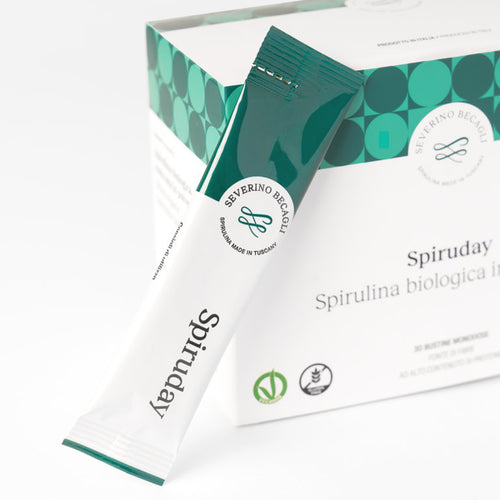
- as Spiruday sachets: handy single doses available in monthly or weekly packs.
To make the most of spirulina's countless properties, you can also use it as a powder to flavour food and drinks such as soups, omelettes, yoghurt, juices, smoothies and shakes.
An excellent choice for different moments of the day.
In any case, remember that the information in this article is not a medical prescription. To treat thyroid disorders and diseases properly, consult a trusted endocrinologist, who can also advise you on whether to take spirulina as a supplement alongside any medication for proper thyroid function.
To stay up to date on the properties and uses of spirulina, keep following our blog.